

Muscle3 min read
8 Rules For Building Muscle
Building muscle is actually quite simple in theory. But in practice,most people are getting at least one of these wrong.
Lizzie Bell
Hey One Percenters!
Why would you deadlift with a controlled lowering phase?
The lowering part of any lift is called the eccentric phase. It’s the part where the muscle is lengthening under load, like lowering into a squat, bringing a dumbbell down from a curl, or lowering the bar in a deadlift.
First, why train eccentrics at all?
Eccentric training has some real benefits, and it’s something we use deliberately with clients.
You’re stronger on the way down -Muscles can handle more load while lowering than lifting. Training this phase lets you work them harder than you otherwise could.
Building muscle-Controlled lowering puts a lot of tension on the muscle, which is one of the main drivers of muscle growth.
Tendon health and injury resilience- Eccentric work is widely used in rehab, particularly for tendon issues, and exercises like Nordic hamstring curls are well known for reducing hamstring injury risk.
Real-life control-Walking downstairs, landing from a jump, lowering a heavy bag to the floor. These are all eccentric movements, and getting stronger at them makes everyday life feel easier.
Better technique-Slowing down gives you time to feel what your body is doing and notice when your position starts to slip.
One thing to be aware of: eccentric work tends to cause more muscle soreness, especially when it’s new to you. That’s normal, and it settles as your body adapts.
With the deadlift, though, the goal is a little different. Here’s why it matters for this lift specifically.
1. It sets you up for the next rep
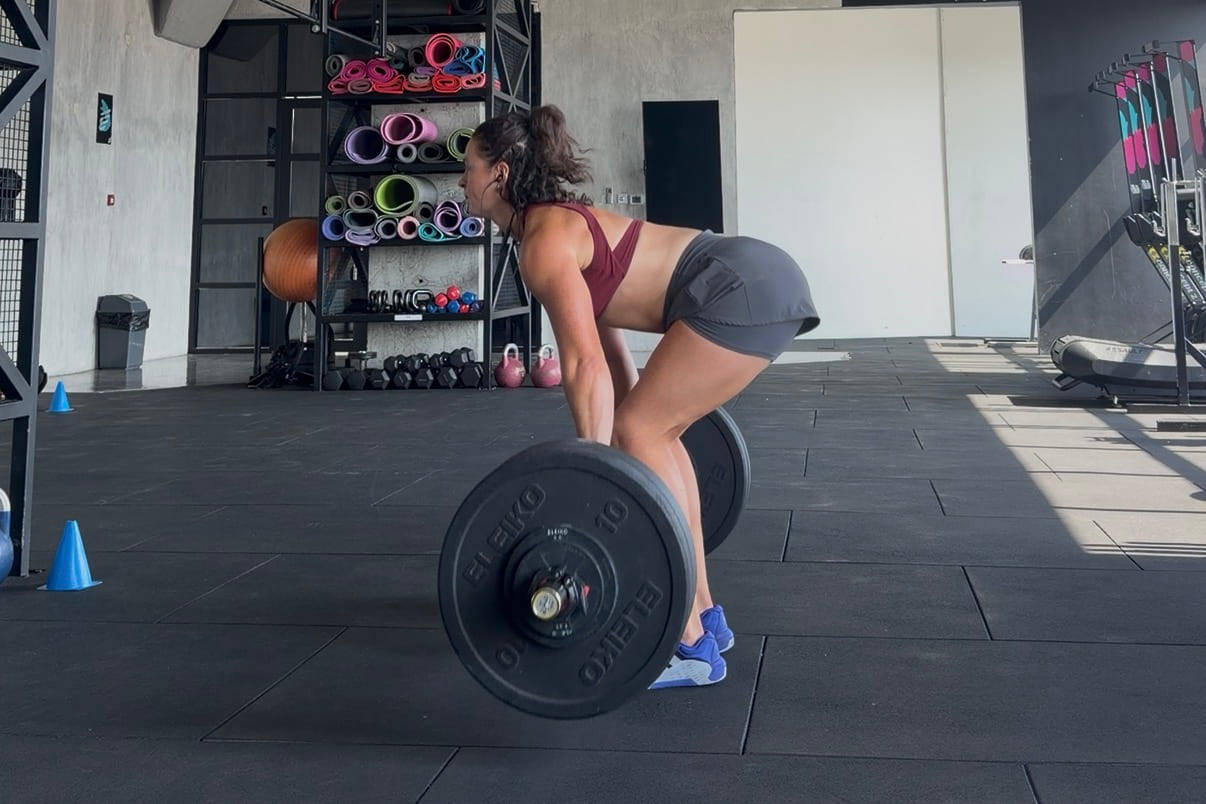
One of the biggest challenges with multiple-rep deadlifts is getting back into a good starting position every time.
Lowering the bar under control helps you:
* Keep control of your hips and torso
* Keep the bar close to your body
* Avoid letting your lower back round excessively
* Let the bar settle in a consistent spot over your midfoot
* Re-establish your starting position before the next rep
Every rep should start like the first one.
2. Bracing is easier at the top than at the bottom
This one often gets overlooked.
At the top of the deadlift, you’re in a much better position to take a breath, reset your core and create a strong brace.
At the bottom, things are much harder. Your hips are bent, your torso is leaning forward, and you have to build tension against the bar before you can pull.
So instead:
1. Lock the deadlift out
2. Take a breath and brace at the top
3. Lower the bar under control
4. Let the plates settle
5. Reset your position and tension
6. Start the next rep
You’re using your strongest position to prepare for the next lift.
Brace where it’s easy, then pull from where it’s hard.
3. Better control, less wasted energy
There’s a balance here.
You don’t need an exaggerated three-to-five-second lowering phase. For most people, that just adds unnecessary fatigue and can hurt your performance on the next few reps.
The goal is to lower the bar efficiently, not slowly for the sake of being slow.
Controlled descent, not an extended negative.
4. Should you do this all the time?
For most people, most of the time, yes.
If you’re newer to deadlifting, or you’re doing working sets where good technique is the priority, a controlled lowering phase and a reset between reps is the way to go. It’s how you build consistency, and consistency is what lets you lift heavier safely over time.
However, there are a few exceptions:
* **Touch-and-go reps:** Some lifters let the plates lightly touch the floor and go straight into the next rep, without a full reset like in crossfit.This keeps the muscles under constant tension, which can be useful for building muscle. It works best for experienced lifters with solid technique and at lighter loads, because there’s less time to correct your position.
* **Very heavy singles:** With a near-max lift, the lowering phase doesn’t need to be slow. The work is done once you lock it out. You still want to keep control, but you’re not trying to squeeze anything extra out of the descent.
* **Romanian deadlifts:** These are a different exercise, where the controlled lowering *is* the point. You’re deliberately loading the hamstrings as you lower, so a slower eccentric makes sense here.
The style should match the goal. If you’re not sure what your goal is for that set, default to control.
Have a great week,
Saul
Keep reading
One-to-one coaching at our private Marylebone studio. Tell us what has stopped working and we will give you an honest answer about whether we can help.
Monday to Friday, 6am–9pm
We would like to use Google Analytics cookies to see how people use this site. None are set unless you accept. Privacy policy

